

 ▶
 ▶
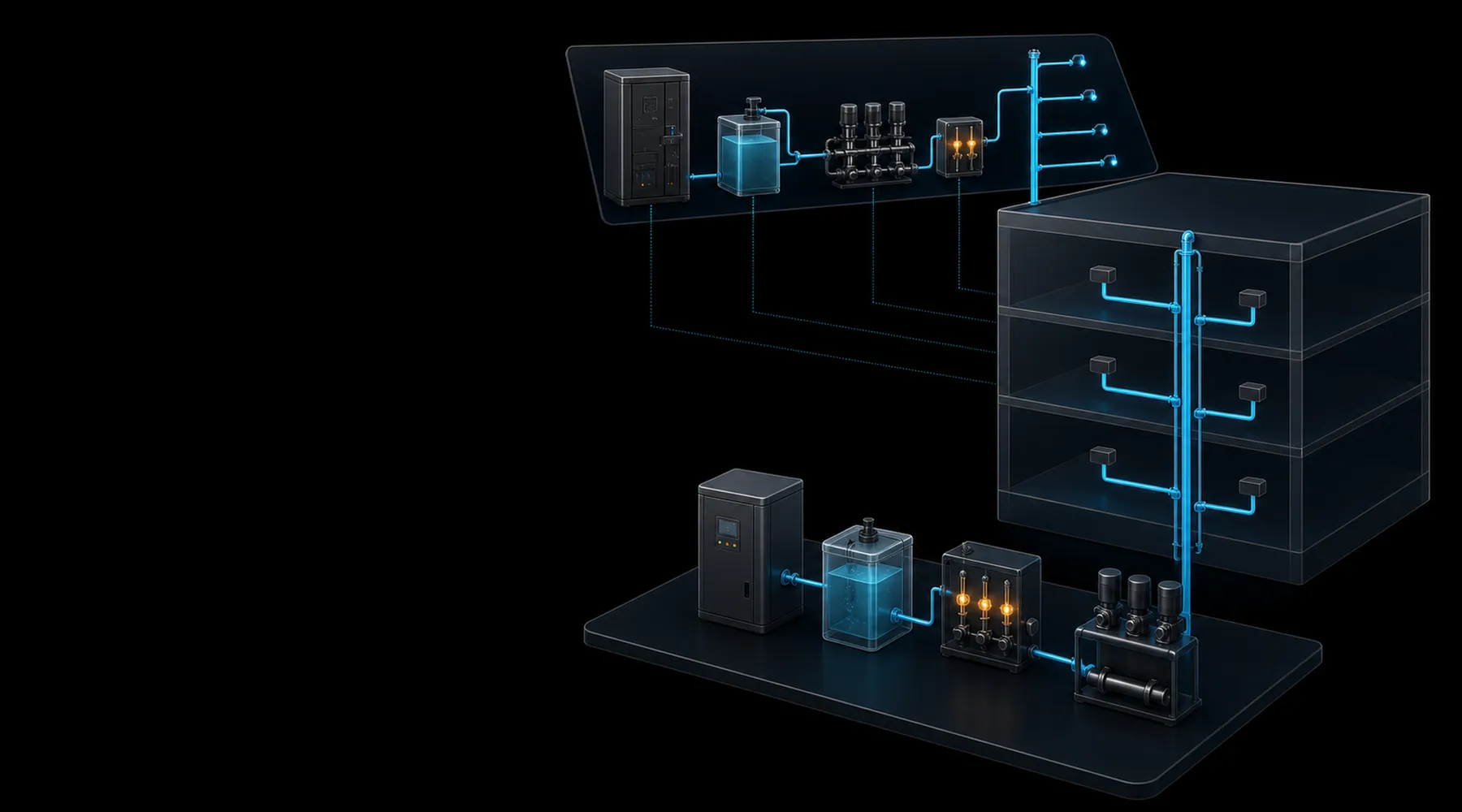 3D illustration created with AI
- Guides
- Practical Guides
- Legionella risk assessment TrinkwV
Practical Guide Buildings
Risk assessment for Legionella in accordance with TrinkwV
If the technical action threshold of 100 CFU of Legionella per 100 ml is reached in a drinking water system subject to inspection, the operator is immediately required to fulfil specific obligations, ranging from notifying the public health authority to carrying out a risk assessment. This page sets out the steps to be taken.
What applies now
- The trigger is the Reach the technical action level of 100 CFU per 100 ml, not just a ‘significant exceedance’.
- Operator’s obligations: to report the matter to the public health authority without delay, to carry out investigations to determine the cause, Risk assessment (Section 51 TrinkwV) and remedial measures.
- ‘Hazard analysis’ is the familiar, older term for the same task; the German Federal Institute for Occupational Safety and Health (TrinkwV) now refers to it as ‘risk assessment’.
- Measures must be assessed for effectiveness and documented.
What ‘100 CFU per 100 ml’ means
The technical action level is not a threshold indicating an immediate health risk, but rather a warning: the installation has a technical problem that needs to be resolved. 100 CFU per 100 ml is therefore not a product trigger: this value does not automatically dictate which technology must be installed, but rather indicates, first and foremost, that the cause and risk must be understood.
What steps should be taken immediately?
Report to the Public Health Authority. Reaching the action level must be reported; the authority may issue further instructions.
Confirm the findings and the system. Assign affected lines, sampling points and measurement history in a reliable manner; carry out follow-up sampling in accordance with recognised guidelines.
Carry out a risk assessment. Systematically assess usage, temperatures, hydraulics, dead-end pipes and potential exposure.
Identify and review measures. Implement structural, operational and, where appropriate, disinfection measures, and demonstrate their effectiveness.
Who can carry out the risk assessment
Risk assessment requires specialist knowledge of hygiene and technical matters: in practice, this is carried out by qualified specialists or specialist planners in drinking water hygiene, who are often familiar with the VDI / DVGW regulations. The operator remains responsible for commissioning and implementing the measures derived from the assessment. Hydreatio does not carry out risk assessments: we implement the technical measures that may result from them.
What distinguishes sampling, root cause analysis and remediation
Three tasks, three roles: The Sampling by accredited bodies provides reliable findings. The Root cause analysis (the crux of the risk assessment) explains why the installation is conspicuous. The Refurbishment addresses the causes at a structural, operational or process engineering level. Continuous disinfection can complement and safeguard the remediation process; it does not replace any of the three tasks.
Frequently Asked Technical Questions
At what level of Legionella do I need to take action?
At a technical action level of 100 CFU per 100 ml. Simply reaching this level triggers the following obligations: notification to the public health authority, risk assessment, rectification of the cause and remediation.
Is continuous disinfection alone sufficient?
No. According to DVGW W551, disinfection is a supplementary measure and does not replace the rectification of structural and operational causes. Both measures are effective when used in combination, provided there is comprehensive evidence to support this.
When technical support is advisable
If contamination is detected again despite thermal disinfection and rinsing, if biofilm is suspected, or if the documentation of hygiene procedures is incomplete, a monitored, parameter-controlled disinfection process may form part of the overall strategy, integrated into the investigation of the root causes and operational management, with recorded data.
Planning measures for drinking water hygiene.
Primary sourcesTrinkwasserverordnung (TrinkwV), in particular the obligations upon reaching the technical action level and Section 51 (risk assessment); RKI, ‘Hygienic quality of drinking water installations subject to inspection’ (as at 30 April 2024); DVGW: Worksheet W 551 (technical guideline, not legislation; check the edition before referring to specific standard provisions). TrinkwV (gesetze-im-internet.de)