

 ▶
 ▶
Article Drinking water hygiene in buildings and facilities
Legionella Management: What to Do When You Reach 100 CFU/100 ml
Legionella monitoring in a large drinking water installation can look like a pass or fail exercise: stay under the limit, move on. That framing misses a distinction that matters operationally. According to section 51 read together with Annex 3 Part II of the German Drinking Water Ordinance (TrinkwV), a concentration of 100 colony forming units (CFU) per 100 ml for Legionella species is a technical action value (technischer Maßnahmenwert), not a statutory limit (Grenzwert). Reaching it, not exceeding it, is what triggers a defined sequence of operator duties in Germany.

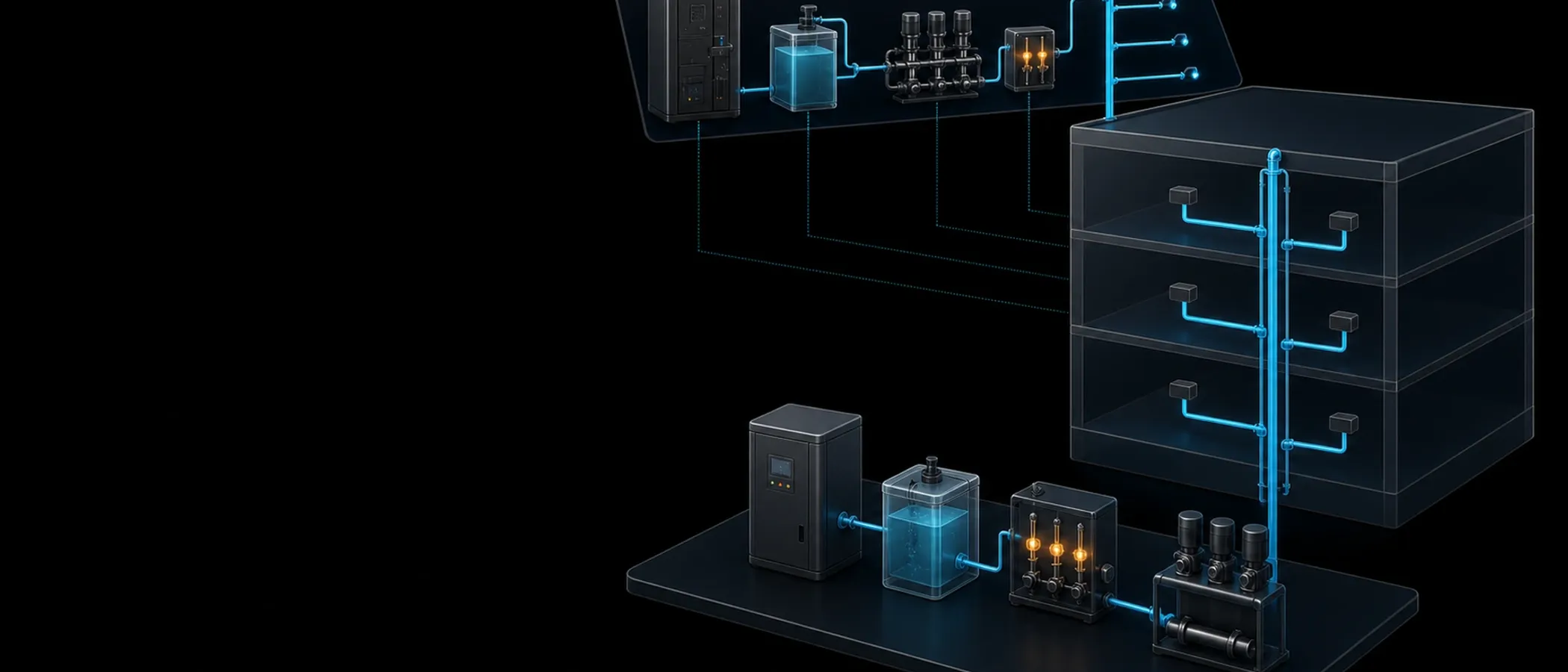 3D illustration created with AI
Under the TrinkwV, Annex 3 Part II sets the technical action value for Legionella species at 100 CFU per 100 ml, and section 51 attaches operator duties to it. This is a threshold for required action, not a concentration ceiling.
For operators outside Germany, the TrinkwV itself does not apply, but the underlying logic, that a threshold is the start of a structured response rather than a verdict, is a useful operational model regardless of which national or regional drinking water regulation governs the site.
This distinction has practical consequences. An operator who waits for a result clearly above 100 CFU/100 ml before acting has already missed the point at which German law requires action to begin. Technical guidance is explicit that a single measured value is a trigger, not a diagnosis: it says nothing on its own about cause, extent or the right remedy. What follows the threshold is a sequence of steps, and getting that sequence right, in the right order, is what separates a defensible response from a reactive one.
What the 100 CFU/100 ml value actually represents
Under the TrinkwV, Annex 3 Part II sets the technical action value for Legionella species at 100 CFU per 100 ml, and section 51 attaches operator duties to it. This is a threshold for required action, not a concentration ceiling. The German term is technischer Maßnahmenwert; it is not a Grenzwert (statutory limit) in the sense of a concentration that must simply not be exceeded. A result at or above this value acquires its real meaning only together with the sampling location, the time of sampling, the condition of the installation and the sampling plan that produced it. The same numeric result can point to a localized problem at one outlet or to a systemic risk across a building, depending on that context. Recommendations issued by the German Federal Environment Agency (Umweltbundesamt), dated 13 October 2025, supplement this picture and can inform how an operator responds.
What happens once the value is reached
Under section 51 TrinkwV, once the technical action value is reached, the operator in Germany must act without delay. The sequence runs through five linked steps: assess the finding, investigate the cause, assess the risk, implement measures, and demonstrate effectiveness. Moving straight to disinfection skips the cause. Investigating the cause includes an on-site inspection and a check of whether the affected installation complies with the generally accepted rules of technology. This is also the point where notification becomes relevant: if there is no evidence that the authorized testing laboratory has already reported the finding to the responsible public health authority, the operator must notify that authority. This duty sits within section 51 TrinkwV and is tied to the testing and notification structure that provision describes; operators subject to other national frameworks should check what their own drinking water regulation requires for notification at this threshold, since the German provision only governs German installations.
Reading the system before choosing a measure
A measured result at the action value does not by itself identify where the problem originates. Good practice is clear that an operator needs to read sampling location, temperature, operating conditions, use pattern, hydraulic connections and other available results together, rather than in isolation. The relevant questions concern the physical condition the measurement is pointing to: is water stagnating in a section of the installation, is part of the system rarely used, are temperatures insufficient to control growth, or is cold water being unintentionally warmed somewhere in the circuit. These questions keep a single intervention from being accepted too quickly as the solution, and establishing which of them applies at the sampling point is what turns a single number into something an operator can act on. A system map that explains how construction, operation and use interact is the basis for this reading, and it is also the basis for the risk assessment that follows: that assessment has to prioritize exposure and probable causes rather than treating every outlet in the building as equally implicated.
Building a defensible action plan
Once the cause investigation and risk assessment are complete, the next step is an action plan that assigns responsible people, sets dates and defines measurable aims. A technical measure is considered to have succeeded only when the intended condition is shown to be stable under real operating conditions and supported by appropriate follow-up sampling, not merely by a single clean result taken shortly after an intervention. This matters because a short-term reduction in colony counts following a disinfection step does not, on its own, establish that the underlying cause, whether stagnation, inadequate temperature control or an unintended warming path, has been resolved. The aim of this process is a defensible remediation strategy: protection is organized, causes are not concealed, and any release decision rests on traceable criteria rather than on a single improved sample.
What this means for your site
For an operator outside Germany, the direct legal duties in section 51 TrinkwV do not apply, since that provision governs installations within the scope of German drinking water law. What transfers is the operational discipline behind it. Treat the 100 CFU/100 ml figure, or whichever action or alert threshold applies under your own national drinking water regulation, as the start of a documented process rather than as a pass or fail line to be announced and then forgotten. Confirm what your own jurisdiction’s drinking water rule actually requires at that threshold, including whether notification to a health or water authority is mandatory and under what provision, since this varies by country and this article cannot state that for you. Separately, build the habit described in this sequence: assess the finding in its system context, investigate stagnation, temperature and material conditions at the sampling point, assess risk realistically, implement a plan with named owners and dates, and confirm effectiveness with follow-up testing before treating the matter as closed. Recommendations from bodies such as the Umweltbundesamt or equivalent agencies in your own country can inform this process.
Have a water related question? Use Hydreatio Smart Match to find the assessment most relevant to your operation. The result provides directional guidance and does not replace laboratory testing, site inspection or expert assessment.
SourcesTrinkwasserverordnung (TrinkwV), official text (gesetze-im-internet.de). Robert Koch Institute, Legionellosis (rki.de). Hydreatio technical report "Legionella in Drinking Water". Technical documentation from Liquid Engineering. Anonymised reference projects. TrinkwV (gesetze-im-internet.de)