

 ▶
 ▶
Article Evaporative cooling systems and cooling towers
42. BImSchV System Type: Classify Before Legionella Duties
Many operators call every open evaporative unit on site a cooling tower. The term is convenient, but in German law it has a narrower meaning, and the category decides which Legionella test values, response sequence and interval logic apply. The rules discussed here are from the 42. BImSchV, which applies in Germany. If your plant is elsewhere, the classification steps below still show what you need to establish, but the legal consequences come from your own national rules.

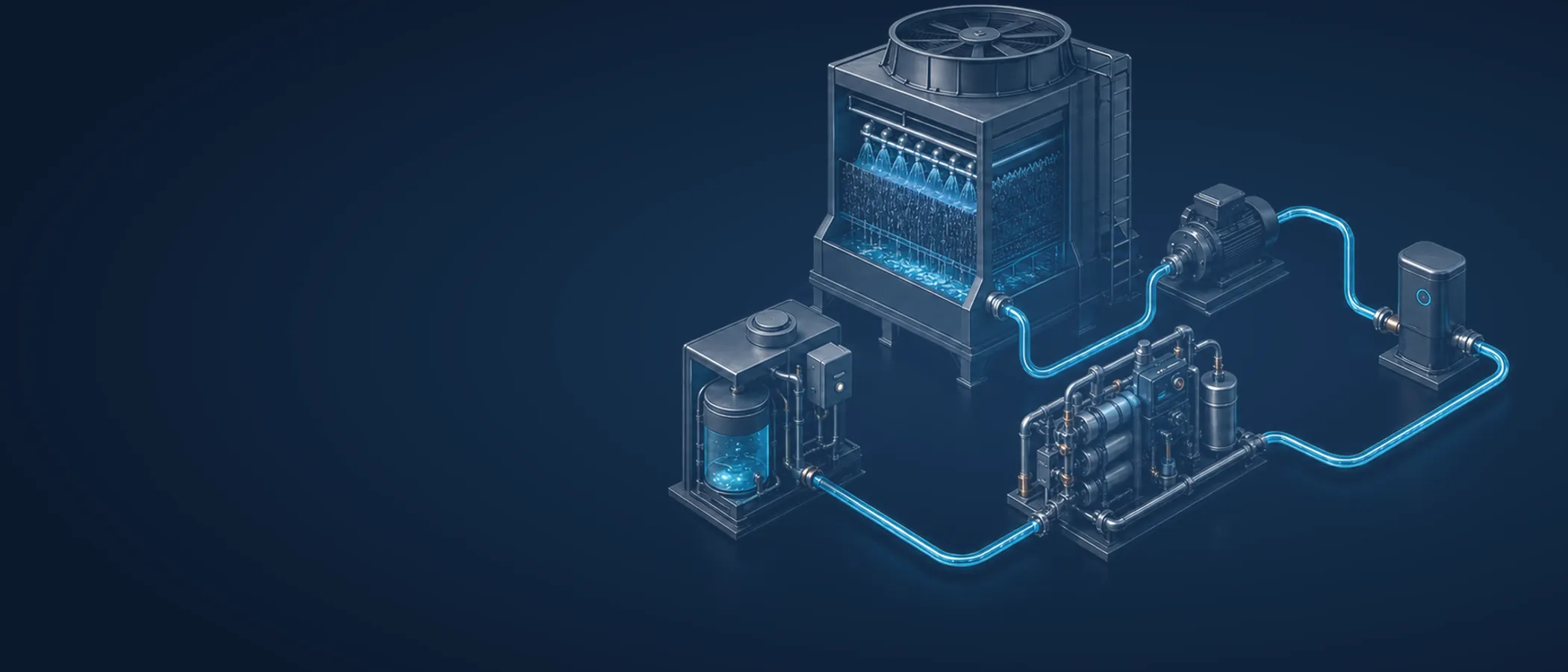 3D illustration created with AI
Start with a written classification of each cooling water system on site, based on the installation's actual design and operating data rather than the label in the asset register.
This article explains how the classification works and why it has to come before any assessment of a result, an inspection interval or a measure. It draws on the Ordinance’s test value table, its definition of a cooling tower and its general design and operating requirements. It does not give a legal opinion on any specific installation.
Why the category comes before the duty
A test result only means something once you know which value it is compared against. The 42. BImSchV sets test values and an action value for Legionella spp. in the process water, expressed in CFU per 100 ml, and the numbers differ by installation category. Reading a result against the wrong row can make a compliant system look like it needs urgent action, or hide a case that does.
The same logic applies to what follows an exceedance. Once a test value is surpassed, a set procedure begins that involves further testing, looking into the causes, carrying out technical or operational measures, and keeping records. Exceeding the action value adds steps such as differentiating the Legionella species, further laboratory tests and, if the finding is confirmed, further measures to avert danger. Which sequence applies depends on the category you assigned, so classification is the first step of the response, not an administrative footnote.
Intervals and test values are linked to the category as well. The intervals differ between the categories, so the system has to be classified against the Ordinance as currently in force before an interval is set.
Three categories, with different definitions
The Ordinance covers evaporative cooling systems, cooling towers and wet separators in which water can be trickled, sprayed or otherwise brought into contact with the atmosphere. Many industrial recooling systems fall into the evaporative cooling system category, which is why the word cooling tower in plant documentation often does not match the legal category.
The legal definition of a cooling tower is narrower. In particular, it means a natural draught unit whose cooling capacity exceeds 200 MW per air outlet. Cooling capacity per air outlet is the central criterion, so a large or tall unit is not automatically a cooling tower in the legal sense. Confirm the figure for your unit against the definitions in § 2 of the Ordinance before you rely on it.
Wet separators fall within the scope and have the same test values as evaporative cooling systems. Classify these units against the definitions in § 2 of the Ordinance, not against the name on the nameplate.
The test values that follow from the category
Anlage 1 of the Ordinance sets the values for Legionella spp. expressed as CFU per 100 ml. Test value 1 is set at 100 and test value 2 at 1,000 for evaporative cooling systems and wet separators, with the action value at 10,000. The values for cooling towers as legally defined are 500, 5,000, and 50,000. Check the current consolidated text before any decision.
These values only work in the right order: assign the category first, compare the result with that row second, and only then decide which sequence applies. A result above 100 but below 500 CFU per 100 ml exceeds test value 1 for an evaporative cooling system or a wet separator, which points to the sequence in § 6 of the Ordinance.
For a cooling tower in the legal sense, the same result stays below test value 1, so the cooling tower provisions in § 8 are not triggered at that level. Getting this wrong means applying the wrong response to the same number.
General design and operating requirements
Whatever the category, the Ordinance’s general requirements for design, construction and operation apply. This is an obligation to prevent microbial contamination of process water, particularly by Legionella, in accordance with the state of the art. The enumerated components include appropriate materials and operating agents, minimal droplet discharge, avoidance of stagnant areas, drainage that is as complete as possible, dosing capacity, suitable measuring and sampling provisions, and routine maintenance.
These requirements matter for classification because they show what the system must be able to demonstrate. A unit without a usable sampling point or without proper drainage can struggle to follow the response sequence even when its category is clear. The wording, scope and any exceptions are in § 3 of the Ordinance and should be read in full.
Interruptions carry their own duty. When the process water circuit has been out of service for more than one week, specified inspections are required prior to its restart. Those checks are set out in Anlage 2 of the Ordinance, which covers measures before commissioning or recommissioning. We have not reproduced their content here, so consult the Anlage directly before restarting a system after a longer stop.
What this means for your site
Start with a written classification of each cooling water system on site, based on the installation’s actual design and operating data rather than the label in the asset register. For each system, record the category you assigned, the basis for that assignment (for a cooling tower, the cooling capacity per air outlet), and the version of the Ordinance text you used. Mark any unit whose category cannot yet be decided from the data you have, and treat it as open until it is resolved.
Next, check the test value row that belongs to each category against the laboratory reports you already hold. Look for results compared with a row that does not match the category, and for interruptions longer than one week that were not followed by the defined checks. Also confirm that the features the Ordinance names, such as drainability and sampling points, are actually present, because a missing sampling point slows every later step.
Finally, agree in advance who classifies the system, who signs off the classification and who starts the response sequence. The category determines which sequence a finding enters, so the responsible role should be named before the first exceedance rather than during it. The figures and duties above come from the German Ordinance. Operators outside Germany should check with their own authority whether a comparable framework applies, because the sources here do not establish an equivalent elsewhere.
Have a water related question? Use Hydreatio Smart Match to find the assessment most relevant to your operation. The result provides directional guidance and does not replace laboratory testing, site inspection or expert assessment.
Sources42. BImSchV, Anlage 1, official text (gesetze-im-internet.de). Hydreatio technical report "Managing Cooling Tower Hygiene". Technical documentation from Liquid Engineering. 42. BImSchV (gesetze-im-internet.de)