

 ▶
 ▶
Article Supplier-neutral water planning
Water Efficiency First: A Structured Approach for Industry
For an industrial site that uses a lot of water, the first useful step is a clear picture of how that water is actually used. A water balance from intake to discharge shows which streams matter, where water is lost and where it could be recovered. That picture comes before any decision about treatment technology.

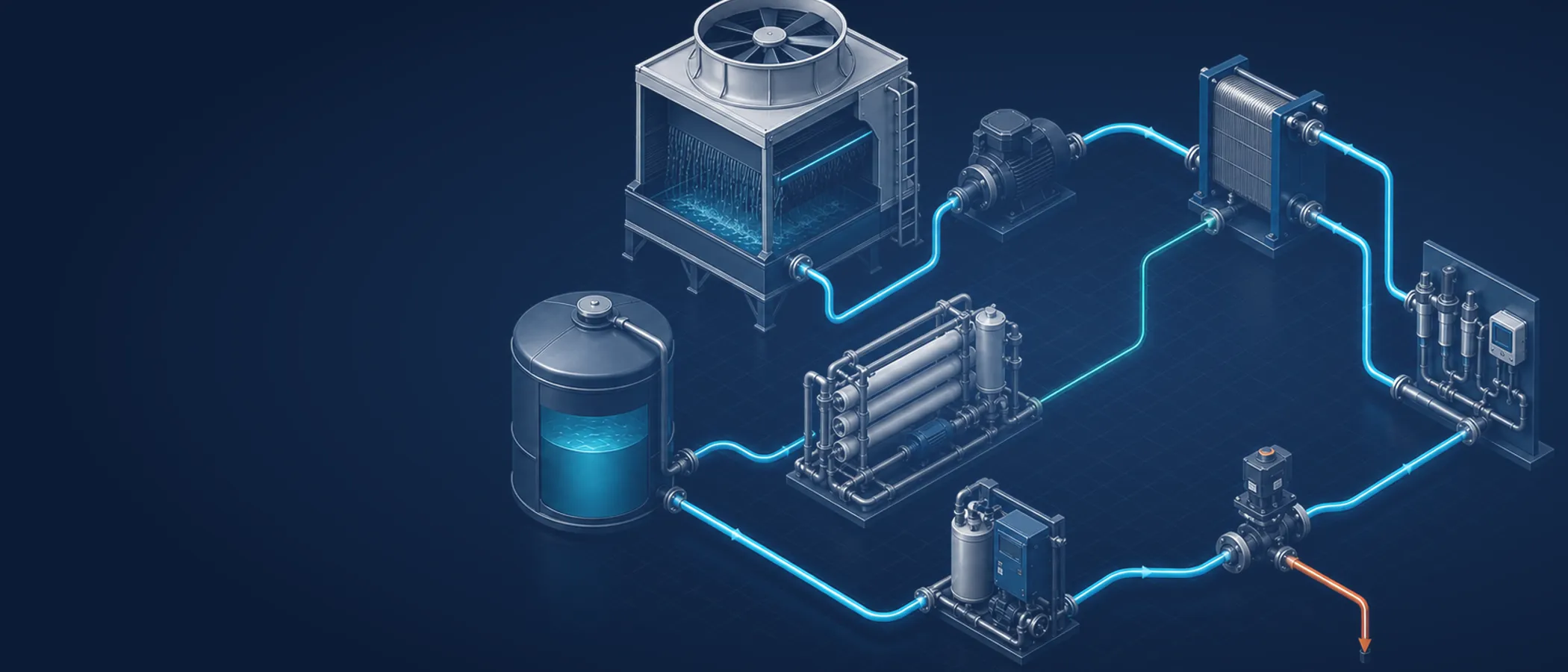 3D illustration created with AI
For a single site, the principle gives a clear order of work, not an automatic savings figure.
European policy points in the same direction. Under a stated principle of water efficiency first, the European Water Resilience Strategy, dated 4 June 2025, aims to raise water efficiency by at least 10 percent by 2030. The target is not legally binding on companies. It is best read as policy direction and funding context, and the practical work of applying the principle happens site by site.
Technology follows the function
Many water treatment projects start by choosing a machine. In complex industrial water systems this is risky, because a premature product choice can overlook pretreatment, side streams or operating limits. One technology rarely solves every requirement: softening, filtration, membranes, biological treatment, disinfection and recirculation address different substances and goals.
A more robust sequence considers five decision levels together: demand, quality, treatment process, interfaces and operation. Only when water streams, quality targets, operating states, residuals and interfaces are understood can a suitable technology combination be chosen. Manufacturer-independent planning places products within that task, rather than adapting operation to a machine chosen in advance.
A neutral comparison covers more than achievable outlet quality. It looks at how a process copes with changing feed water, what residual streams it produces, how well it can be cleaned, and how much energy, chemicals and operator effort it needs. It asks under which conditions a performance promise applies, and who carries the risk when conditions depart from them.
The plant audit as the shared evidence base
The starting point is an audit of the real system. It maps the water paths, users, storage, wastewater streams and measurement points that actually exist, and the modes in which the site is really operated. Historical data are checked for gaps and plausibility, with attention to manual bypasses, seasonal settings and flushing that is needed regularly.
Drawings, measured data and daily practice have to describe one and the same system; where documentation and reality differ, that difference is itself an important audit result. The system model then assigns flows, qualities and responsibilities. It shows which data are missing and which assumptions make an investment decision uncertain. This transparency is often the first major benefit of an independent assessment, before any technical recommendation is made.
Quantity and quality in one balance
The balance links what enters the site, what is used, what evaporates, what leaves bound into product, what is returned and what is discharged. It shows which streams matter most by volume, where water is lost and where it could be recovered. Each stream is then assessed by its real quality and by the quality required at its next use.
This is where reuse becomes an allocation problem: the next purpose sets the necessary standard. Not every user needs drinking-water quality, and not every discharge stream is unusable without treatment. Matching quality to purpose can create suitable loops, provided accumulation of substances and cross-contamination are reliably limited, so that each use receives only as much quality as it needs.
Reuse also raises a question of risk. The German Environment Agency (Umweltbundesamt, UBA) publishes information on water reuse and points to the necessary assessment of risks to people and the environment. For the design, our white paper on manufacturer-independent water treatment draws a practical consequence: supply only as much quality as each use needs, with explicit limits for accumulation, hygiene and process stability.
Standards and rules, and what they do not say
Several frameworks touch on water efficiency, and each of them does a different job. ISO 46001:2019, Water efficiency management systems, with Amendment 1:2024, gives operators a management system standard for the topic. It treats water efficiency management as a continuing task of monitoring, measurement, documentation and reporting that extends into design and procurement. Its current revision status should be checked with ISO before it is cited in a project.
Directive 2010/75/EU, in its consolidated version of 4 August 2024 including Directive (EU) 2024/1785, describes integrated industrial aims that include emissions reduction, waste prevention, resource efficiency and circularity. The Water Resilience Strategy, as noted above, sets a policy direction without binding companies. Keeping the standard, the directive and the strategy apart avoids presenting a direction as an obligation.
What this means for your site
For a single site, the principle gives a clear order of work, not an automatic savings figure. First map the actual water paths, users, storage and wastewater streams, including manual bypasses, seasonal settings and regularly needed flushing. Then set up the water balance and assess each stream by its real quality and by the quality required at its next use.
When options are compared, supplier figures should be translated to a common feed range, target quality, temperature, load and availability before costs or performance are compared. The benefit is decision quality: assumptions become visible, offers comparable, risks testable and performance verifiable in service. Where feed composition, fouling or biological response is uncertain, a pilot can reduce investment risk, as long as it answers a question the investment decision actually depends on. Each site has its own water paths, quality requirements and constraints, so no general savings rate follows from this approach.
The last step is acceptance. It should test rated load, part load and transitions such as startup, shutdown, cleaning and alarm, together with the underlying records and the people responsible. What is accepted should be an operable, documented system rather than a nameplate capacity. Each measurement point recorded at that stage needs a purpose, a plausibility rule, a response and an owner.
Have a water related question? Use Hydreatio Smart Match to find the assessment most relevant to your operation. The result provides directional guidance and does not replace laboratory testing, site inspection or expert assessment.
SourcesEuropean Commission, Water Resilience Strategy Actions Tracker (environment.ec.europa.eu). Hydreatio technical report "Manufacturer Independent Water Treatment". Hydreatio technical report "Operator Models for Water Treatment". Technical documentation from Rotreat and Liquid Engineering.